
Life on the Seesaw – Rethinking Balance in a World on Tilt
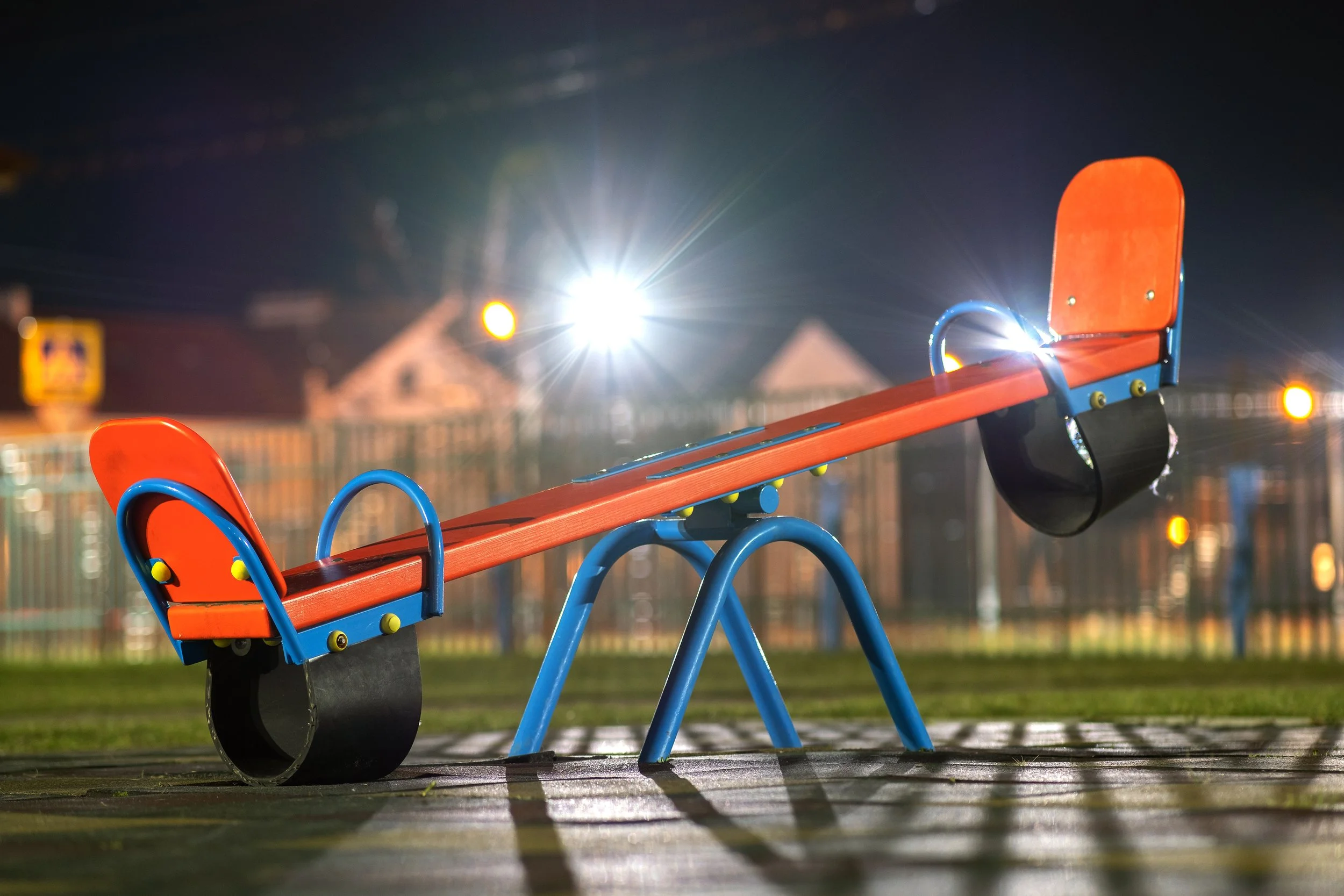
If your quest for balance feels like being at the park on a seesaw with a giant kid on the other side—where you long to dangle in that light, euphoric joy but instead keep slamming up and down—you’re not alone.
You’ve got company.
Not just in the metaphoric “Big Bad” of one of life’s domains—Time Management & Life Dynamics, Family & Community Connectedness, Physical Well-being, Mental Well-being, Career & Lifelong Learning, Financial Management, Core or Spiritual Development—sitting heavy on the other end of your seesaw and calling the shots.
You’ve got hoards of fellow humans trying to find equilibrium while facing circumstances that, in many ways, are unprecedented.
Anxiety and depression are skyrocketing. We find ourselves living in the extremes.
There is a bounty of information and resources, yet a dire lack of wisdom and application.
The coveted “work from home” quietly morphed into “live at work.”
Then there was the pandemic.
Necessary social distancing helped reduce infections—but it also pulled at something deep in us. Masks, while useful, added extra load to our already overworked nervous systems. They made it harder to read nonverbal facial cues, and that matters because facial expression is a huge part of how we connect and feel safe. Our anterior cingulate cortex—the brain region involved in detecting errors and conflict—doesn’t love it when it can’t clearly distinguish one thing from another.
The result?
More arousal. More misread signals. More friction in moments that were already fragile.
And you might be like me—weary of the list.
Weary of hearing what’s wrong.
Weary of how much is out of our control.
So I often come back to this prayer:
“God, grant me the serenity to accept the things I cannot change,
the courage to change the things I can,
and the wisdom to know the difference.”
Many of us are feeling out of balance. So here’s the real question:
If so much is out of our control, what then can we change?

One starting point:
How we see balance.
How we seek balance.
I’m not here to hand you a GPS pin labeled “Perfectly Balanced Life – Turn Here.” I’m inviting you instead to rethink the whole concept with me. To consider that balance may not be a static destination or a flawless daily schedule, but something far more dynamic, humble, and alive.
This series is about that rethink.
We’ll explore:
What balance actually is (and what it isn’t).
The “lesser goals” that quietly steal our focus.
Why your design and purpose shape what balance must look like for you.
Why balance is dynamic, not static.
And why consistency—not perfection—is where the real traction lives.
For now, let’s start simple:
Balance might not be about finally getting the seesaw to freeze.
It might be about learning how to move with the weight on the other side without losing yourself.
Before You Take the Next Step: Reflection & Action
Use these questions as a quiet audit. Evidence from coaching and behavior change research tells us that naming what’s real is often the first effective step toward change.
On a scale from 0–10, how “slammed around” do you feel by life right now (0 = fully grounded, 10 = constant whiplash)? What makes you choose that number?
When you think about balance, what picture comes to mind—a schedule, a feeling, a bank account number, a title, a season? Is that picture serving you or quietly stressing you?
Which of your life domains feels like the “giant kid” on the seesaw right now—Time, Family & Community, Physical, Mental, Career & Learning, Financial, Core/Spiritual? What is it demanding from you?
If you could only change one thing about how you’re pursuing balance over the next 30 days, what would be the most impactful shift?
Complete this sentence in your journal:
“If balance wasn’t about perfection but about steady movement in the right direction, I would start by ________.”
